Trains, buses and driving on the left
Ireland's rail lines fan out from Dublin, buses fill the gaps, and a car opens up the west. Here is how each works across a fourteen-day loop, border included.
Trains: the spokes from Dublin
Ireland's railway network looks like the spokes of a wheel, with Dublin at the hub. From Heuston station, trains run to Cork, Limerick, Galway, Westport, Waterford and Tralee via Killarney. From Connolly station, trains run north to Belfast, north-west to Sligo, and south along the coast through Wicklow to Rosslare. In Northern Ireland, a separate network runs from Belfast to Derry, Larne, Bangor and Newry, with a branch to Portrush on the north coast.
The trains are comfortable and reasonably fast on the main lines, and booking online in advance usually gets you a better fare and a reserved seat. The catch is the gaps. There is no railway in Donegal, on the Dingle Peninsula, in Connemara or along most of the west coast between the main towns, and few lines run across the country rather than out from Dublin. For a loop around the island, trains work best for the start and the end, or for a city-to-city trip such as Dublin to Galway or Dublin to Belfast.
Buses: filling the gaps
Buses reach the places trains do not. The national bus company runs intercity routes linking most towns, and several private operators run frequent coaches on the busiest corridors, such as Dublin to Galway or Cork. In rural areas, local link services connect villages to market towns, though they may run only a few times a day, or a few days a week.
In Northern Ireland, the public transport company runs both trains and buses, with intercity express coaches and local routes, and in summer a seasonal service along the Causeway Coast.
Hiring a car
For most of a fortnight's loop, a car gives you far more freedom, especially in the west and north, where many of the best places are at the end of narrow roads. Car hire is widely available at the airports and in the larger towns. Most hire cars are manual; automatics are available but cost more and run out in summer, so book well ahead if you need one.
Insurance is the part to read carefully. Many credit card insurance schemes do not cover car hire in the Republic, and the hire company may insist on its own collision cover, which adds considerably to the cost. Check the terms, the excess, and any fees for an extra driver or for taking the car into Northern Ireland before you book. If you are planning a fourteen-day loop, ask whether one-way rental is possible and what it costs.
A detourKenmare and the Ring of KerryDriving on the left, and on narrow roads
Ireland drives on the left, and if you are used to the right, the first day or two needs concentration. At roundabouts, traffic goes clockwise and you give way to vehicles coming from the right. The driver sits on the right, so the gear lever is on your left. Take it slowly at first, and let a passenger help with directions.
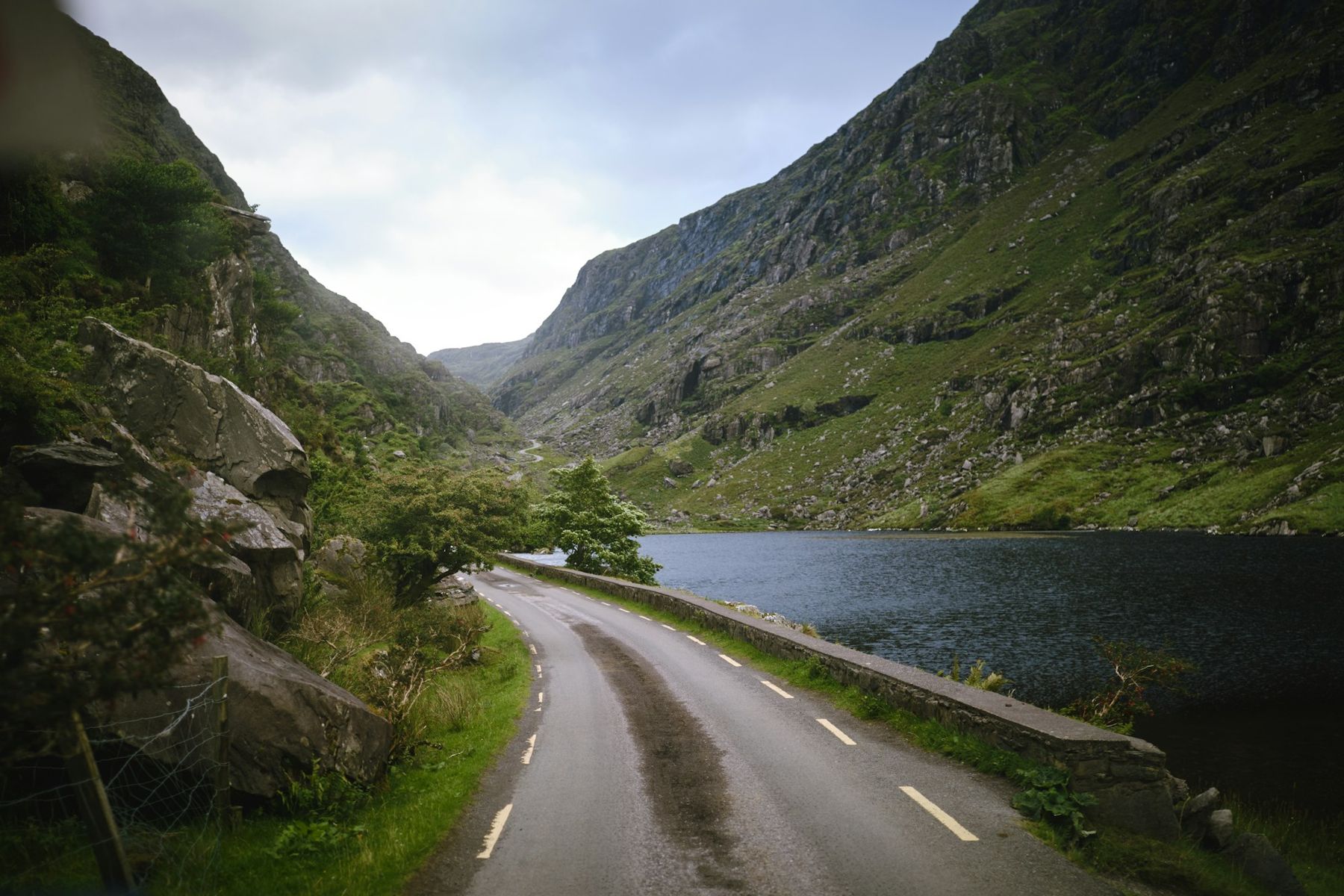
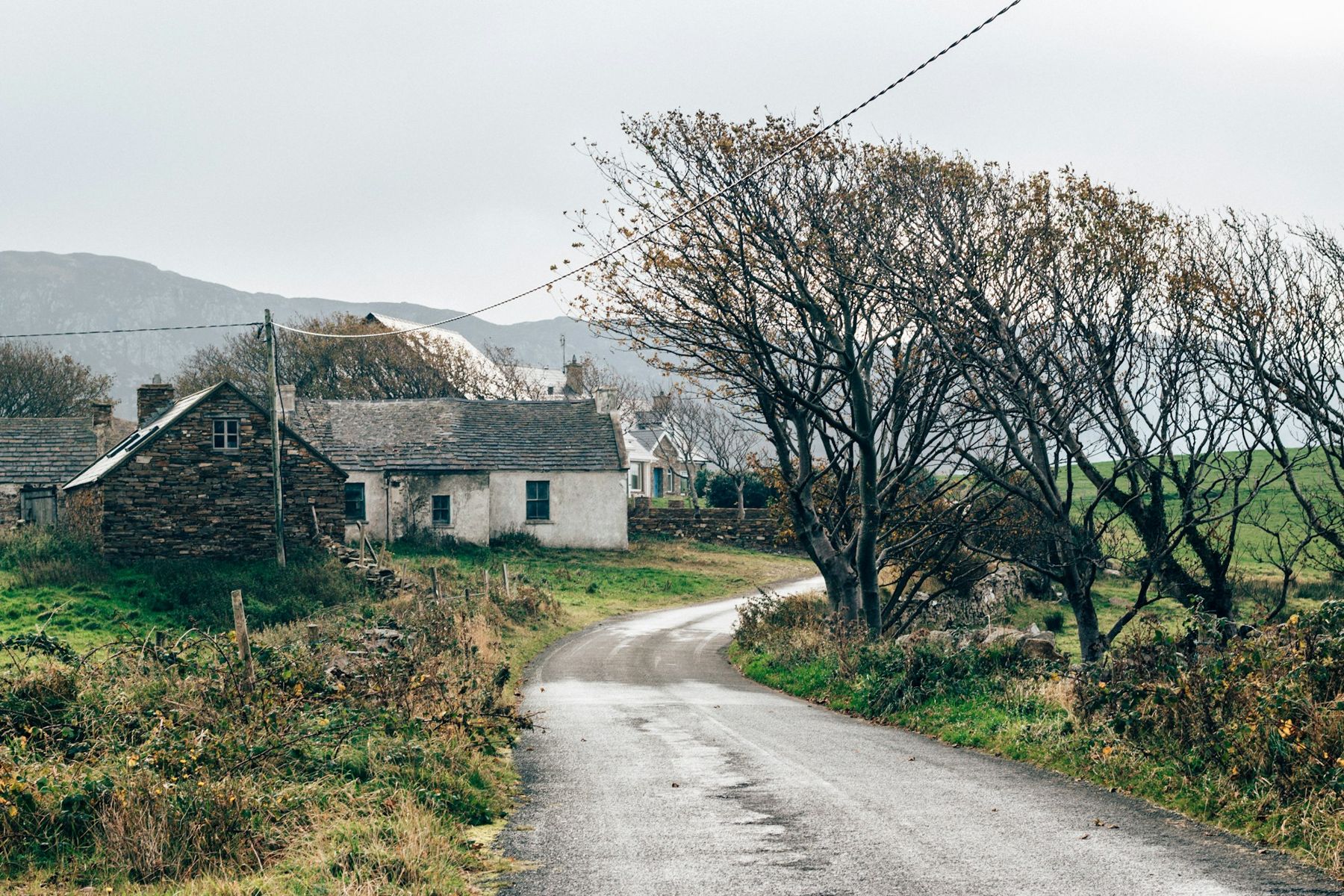
Roads in the Republic are classed as motorways (M), national roads (N), regional roads (R) and local roads (L). Motorways and most national roads are good. Regional and local roads can be very narrow, with stone walls or high hedges on both sides, few places to pass, and the occasional tractor, cyclist or flock of sheep around a blind bend. On roads like those on the Ring of Kerry or around Connemara, allow far more time than the distance suggests.
- Speed limits in the Republic are in kilometres per hour; in Northern Ireland they are in miles per hour.
- The M50 motorway around Dublin has a barrier-free toll that is paid afterwards; check how your hire company handles it.
- Drink-driving limits are low, and enforcement is strict.
- Pay-and-display parking is common in towns; read the signs carefully.
Crossing into Northern Ireland
There are no border posts between the Republic and Northern Ireland. The road simply continues, and the only signs that you have crossed are changes in road markings, speed limits in miles per hour and prices in pounds sterling. Mobile phones may switch networks.
The Republic uses the euro and Northern Ireland the pound sterling, because they belong to different states: the Republic of Ireland is an EU member, while Northern Ireland is part of the United Kingdom. Visitors who are not British or Irish citizens should check whether they need permission to enter the UK, even though there are no checks on the land border. Cards are widely accepted on both sides, but it helps to carry a little of each currency.
Mixing modes over a fortnight
Many travellers combine all three. A common pattern is to spend the first days in Dublin without a car, using public transport and walking, then pick up a car when leaving the city. At the end, you might drop the car in Belfast or back in Dublin and take the train between them. Ferries to the Aran Islands, Clare Island, Rathlin and other islands run from small harbours, mostly for foot passengers.
Whichever way you travel, build in slack. Irish distances look small on a map, but slow roads, sudden rain and the temptation to stop at every viewpoint mean a day's travel often takes longer than you planned.